Building Autonomous Workflows: How to Combine Multiple AI Agents

Building Autonomous Workflows: How to Combine Multiple AI Agents

Building Autonomous Workflows: How to Combine Multiple AI Agents

As AI technology evolves, single-agent systems are giving way to multi-agent architectures, where several specialized AI agents collaborate to complete complex tasks. These systems mirror how teams operate in software engineering—each agent performs a dedicated role, coordinating through defined interfaces or protocols. The result is a highly scalable, autonomous workflow capable of handling everything from document analysis to customer support and business process automation.

Why Use Multiple AI Agents

Single large models can solve broad problems, but they often lack modularity and interpretability. Using multiple smaller, purpose-built agents offers key advantages:

  • Modularity: Each agent specializes in a function—data extraction, reasoning, summarization, decision-making.
  • Scalability: You can add or upgrade individual agents without redesigning the entire system.
  • Autonomy and coordination: Agents can operate asynchronously to manage larger workloads.
  • Resilience: Workflow failures can be isolated to specific components.

For example, a credit risk platform might use one agent for financial data ingestion, another for scoring, and a third for report generation—all coordinated through an orchestrator service.

Architectural Patterns for Agent Collaboration

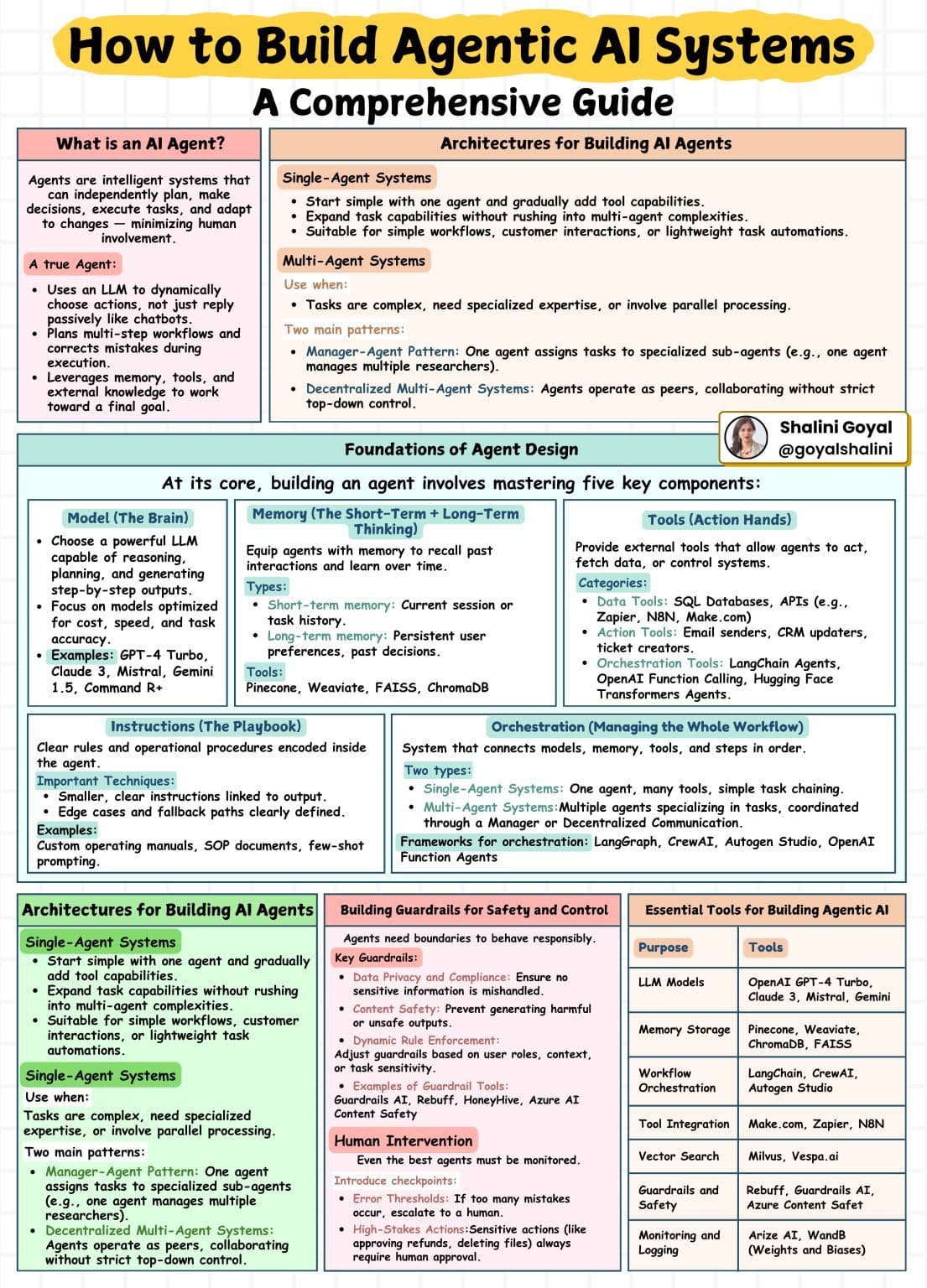
There are several ways to connect and manage AI agents within a workflow:

  1. Orchestrator Pattern:
    A central “controller” agent manages tasks, delegates subtasks to specialized agents, and merges outputs. This setup is ideal for deterministic workflows like document processing or data enrichment.

  2. Hierarchical Agent Network:
    Agents are arranged in layers—executors handle tasks while supervisors oversee reasoning or validation. This structure works well for complex reasoning or compliance-driven environments.

  3. Fully Autonomous Collaboration:
    Agents negotiate and cooperate through shared memory, message passing, or a common knowledge graph. This decentralized pattern enables open-ended problem solving but requires careful control over prompt design and goal alignment.

Tools and Frameworks for Multi-Agent Systems

Recent open-source frameworks and LLM orchestration tools make building multi-agent systems much easier:

  • LangChain or LlamaIndex: For chaining tasks and managing agent conversations.
  • OpenAI ReAct or function-calling agents: For structured reasoning with tool integration.
  • Flowise or Dify: For visual workflow design and API connectivity.
  • Graph-based Coordination (e.g., Neo4j): For representing agent relationships and dependencies.

Implementation Strategy

A typical multi-agent workflow design often involves the following steps:

  1. Define granular roles: Determine what each agent does—classification, retrieval, or decision-making.
  2. Establish communication channels: Use message queues, APIs, or shared vector databases.
  3. Develop orchestrator logic: Implement a control layer that sequences or parallelizes agent calls.
  4. Add monitoring and logging: Track each agent’s actions and performance for debugging and optimization.
  5. Refine coordination via feedback loops: Use reinforcement or prompt optimization between agents.

Example Use Case: Automated Knowledge Workflow

Imagine building a knowledge processing system for a consulting firm:

  • Agent A (Retriever): Searches company documents and client data.
  • Agent B (Analyzer): Extracts risk factors and financial signals.
  • Agent C (Summarizer): Generates structured insights for reports.
  • Agent D (Quality Checker): Validates accuracy against business rules.

All agents communicate through an orchestrator that assigns tasks, aggregates outputs, and triggers alerts for human review when necessary.

The Future of Multi-Agent Intelligence

The next frontier lies in teaching agents to cooperate dynamically with minimal supervision. With emerging open-weight LLMs, graph-based knowledge stores, and agentic memory, multi-agent ecosystems are evolving into self-improving digital organizations. For developers, this means moving from prompt writing to workflow architecture—designing interactions that mimic intelligent teamwork.


Comments

Loading comments...